
Sammy Jones 'checks in' to discover the fascinating past of one of the area's longest serving hotels...
The town's church has been welcoming worshippers since the 14th century, but the briefest of walks away from the religious focal point, visitors to Newport Pagnell find The Swan Revived Hotel, which has been a place for travellers to rest their weary heads for centuries.
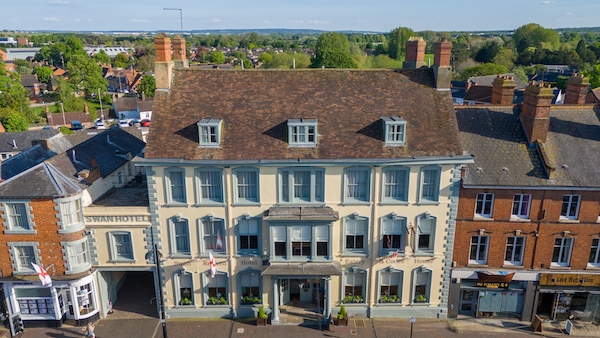
The pretty facade, three storeys tall and adorned with beautiful blooms during the summer months, makes a stunning statement and teases you to step inside. People have been doing just that since the 1600s, with the earliest mention of the building in use dating to 1597.
It is believed that an inn has occupied the same site for even longer - as far back as the medieval age.
During its days as a coaching inn, The Swan delivered respite for horses and owners alike, with stabling and board as standard, and it would have been a-buzz with a flurry of those horse-drawn coaches, given its prominent position – Newport Pagnell was, for centuries, an important route for travellers.
Indeed, by the late 17th century close to 200 goods and coach services passed through the town every week and The Swan Inn was one of many hostelries in the town.
During the 1820s, modernisation came calling and the building underwent renovation.
The Swan in days gone by - image courtesy of Don Hurst
That it still operates as per its original intention is wonderful, but that The Swan still exists at all is down to the gallant efforts of firefighters, given that a blaze in June 1880 completely destroyed its neighbouring inn, The Saracen's Head.
That building, itself of significant importance, was used as the HQ for Sir Samuel Luke during the town's occupation by the Roundhead troops during the English Civil War.
The Swan escaped the fate which befell its neighbour and key competitor, but it was damaged, and the current facade was added during repair work following the blaze.
The Swan continued as an important place not just for visitors, but for townsfolk; it was a regular focal point for meetings by the local business fraternity, and for sales and auctions, details of which would be published in local media outlets.
Public meetings included a summons against the Newport Pagnell Railway Company, who had proposed to build three bridges in the town's Bury Field, as part of the planned Newport to Olney train line. Issues with finance meant those plans were eventually derailed.
In 1860, Henry Fountain held the reins of the hotel, and three years later he put his entrepreneurial skills, and the resident horses, to good use, by launching the Newport Pagnell, Wolverton and Olney Omnibus Service.
The service used to depart Olney at 7am, trotting in to Wolverton at 8.35am. It ran for many years and became known as the Swan Bus.
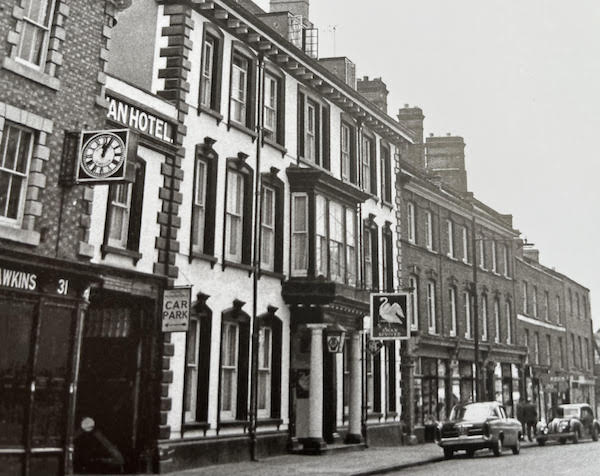
Pic courtesy Don Hurst
Where the car park now occupies the space to the rear of the property, it was previously stabling for the animals. They played another crucial role too; pulling the town's fire engine, a practice that continued through to 1912.
The Swan Bus would often be interrupted mid-journey so the brigade could make use of the horses during incidents!
While those beautiful beasts and their hard work no longer live even in the memories of present day townsfolk, the very engine they used to pull is now a resident at Milton Keyns Museum, and can be viewed in the Transport Hall.
The need for stabling disappeared with the arrival of the motor car, but a hearty meal and a clean bed are still paramount for journeyers.
The Swan Revived, as it became known in the 1950s, has offered its uniformly warm welcome to many familiar faces, though quite how the building would have looked to its earliest known public figure to have visited, we can only imagine.
Samuel Pepys, the famous diarist, recorded of his stay on Monday, July 8, 1668: 'At night to Newport Pagnell; and there a good pleasant country-town, but few people in it.'
Pepys was passing through in the aftermath of the plague, which had seen half of Newport Pagnell's population succumb.
Who knows who else might have stepped over its threshold in the ensuing decades and centuries, visits lost in the midst of time. We do know that British Prime Minister Benjamin Disraeli partook of its comfort during the year he became PM, in 1874.
In the middle of the 20th century, glamour came calling, with Hollywood stars including Carey Grant and David Niven, and Sophia Loren, who was in town to film Arabesque with Gregory Peck, getting some shut-eye there.
“I had the job of putting in a TV for Sophia,” recalled Norman Lyman, “I did all the electrical work at Frith Radiocraft – a business opposite The Swan – and got the order.
“I was never a cinema-goer at all in those days, but remember chatting away with her while doing the installation. She was very pleasant and very glamorous!”
If you believe in ghosts and ghouls and things that go bump in the night, you might also believe that some visitors refuse to leave!
As with all places of age, eerie and unexplained tales seem to follow as standard – and The Swan Revived Hotel is no exception.
When I was growing up in the area, the story of the Grey Lady was an omnipresent part of local history, or folklore, depending on your perspective.
The Swan Revived's current owner Mark Bryant with resident pooch Gus
Then there is the story of the Grey Soldier, and its many variations, which we could fill this feature with, so many are there!
But the one pertinent to this piece is that the soldier enlisted the charms of a young lady, before she later reached her untimely end in the River Ouse close by.
Legend says the soldier then returned to The Swan Hotel and took his own life.
There are no records to confirm this, but there is something morbidly alluring to think this could be true, and it is remarkable to think that generations have kept the story alive for literally 100s of years.
Mark Bryant is the current owner of the hotel and can vouch for those 'visitors' who refuse to check-out: “There has been unexplained whispering in ears, and glasses have been known to fly off the shelves and tables,” he told Total MK.
Mark and his family have held the reins of this magnificent building and business for the past 40 years, and these little unexplained moments certainly don't add fear, but rather character to the place.
There are quirks and historic charm throughout, including, "a lovely Jacobean staircase which takes you to the top floor of the building...”
It is a feature shared with other buildings in the High Street and the belief is that once upon a time there was a carpentry 'school' in the area, which would have been a hive of activity with those employed working to deliver for local properties. That they have lasted so long, speaks volumes for the craftsmanship at work.
“And of course the wonderful wood panelling in the lounge...” Mark said.
The Swan is known for its welcoming nature for all, pooches included, but one visitor didn't act so respectfully when he punched the panelling during a domestic incident.
The wood broke, but in doing so the building gave up another secret – the damage exposed some very old wallpaper beneath!
Mark employs a staff of 40 who all play their part in ensuring that a stay at The Swan Revived is memorable for all the right reasons.
The hotel retains a traditional charm, but with a necessary modern feel – how easy is to strike that balance?
“We always ensure that everything here is traditional in our hospitality and service,” Mark added, “We are very proud to be the custodians of such an important part of the Newport Pagnell story, and love sharing its history with our guests. It's part of the charm, isn't it?
“We hope future guests will receive that same warm welcome from those who inherit the history, and make more of their own, when they one day follow in our footsteps...”
Additional information:
Newport Pagnell Historical Society
One More For The Road - The History of Newport Pagnell's Inns and Public Houses (Donald Hurst and Dennis Mynard)