
Life rushes by so press pause for an evening of movement, music and melodrama – Matthew Bourne’s production of The Red Shoes is as mesmerising as ever, writes Georgina Butler.
Once a dancer, always a dancer? There is something about dance that seems to inspire a ritualistic, fanatical devotion.
Dancers don’t want to dance. Dancers need to dance. Once bitten by the boogie bug, dancing is an itch that must be scratched. And, unlike other art forms, the dancer is the dance – the artist’s own body is the instrument, the canvas and the masterpiece itself.
Inevitably, sacrifices must be made to succeed professionally in an industry that demands people constantly prove who they are and why their dancing matters. There is no greater sacrifice than that made by fledgling ballerina Victoria (Vicky) Page in British film-making duo Michael Powell and Emeric Pressburger’s intoxicating backstage drama The Red Shoes, released in 1948.
Embroiled in a tragic tug-of-war between professional artistic obsession and personal human love, Victoria (flame-haired Moira Shearer) is compelled to choose dance over a normal life, ultimately dancing to her death. Matthew Bourne’s sumptuous production, gloriously realised in his dance–theatre style, is a true love letter to the film, to the arts and to the dreamers and doers who dare to dedicate themselves to what sets their heart ablaze.
Ten years since its creation, Bourne’s production of The Red Shoes is still performed with passion, power and poignancy by his company, New Adventures. (The company comprises cast members who are returning to roles they created in 2016, as well as more recently recruited dancers.) What is particularly notable about this show is that it demonstrates how deeply in love with dance Bourne is.
The intense dialogue that the film is renowned for may be missing, but it is not missed. The choreography creates utterances and conversations that are declared and developed to dynamically communicate ambition, admiration, amusement, romance, manipulation, desperation. Victoria’s emotions become our emotions: she is excited, enthralled, enchanted and exhausted by what is happening in her life – and so are we.
The action takes place in London and the French Riviera in the late 1940s. Essentially, Victoria has the heart for the art of dance but does not have the stomach for the business of dance. When she is first presented to imposing impresario Boris Lermontov as a prospective apprentice dancer, his interest in her is guarded. Lermontov is a hard taskmaster. He demands total commitment to the religion of ballet, which includes the rejection of romantic love. As time passes, Lermontov’s interest in Victoria evolves into a controlling, possessive mentorship.
When Irina Boronskaya, prima ballerina of Lermontov's company, is injured, Lermontov casts Victoria as the lead in his new ballet, The Red Shoes. Victoria plays a peasant girl whose coveted crimson slippers force her to dance until death. Her performance is a triumph.
Things become complicated when romance blossoms between Victoria and the ballet’s composer, Julian Craster. Torn between the manipulative man who promises to keep her dancing in the spotlight and the musical man who promises to keep her basking in his love, Victoria descends into an existential crisis. Her grip on reality shatters and she is seized by an irresistible impulse that sets her on track to mirror the fate of the protagonist in The Red Shoes.
The staging, marrying Bourne’s fluent direction and choreography with Lez Brotherston’s gorgeous sets and costumes, is sublime, surreal and shocking in all the right places. The main set piece is a double-sided proscenium arch, with opulent moving curtains. This mobile theatrical frame rotates and glides to seamlessly transition between onstage, backstage and all-the-world-is-a-stage moments. The ever-shifting perspective beautifully conveys the blending of life and art, revealing the hidden effort required to achieve apparent ease.
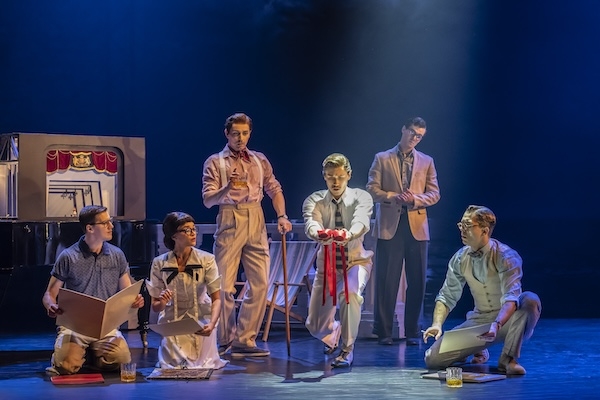
Bourne's well-paced integration of behind-the-scenes happenings ensures we see every aspect of the dancers’ working lives as part of Ballet Lermontov. Training in class (the condensed barre exercises, executed with casual mundanity, are a delight).
Toiling through full-cast rehearsals. Marking choreography in technical rehearsals (multiple pirouettes are a breeze when your index finger is doing the twirling). Dazzling during performances. Collapsing, commiserating and celebrating in the wings. There is an all-or-nothing mentality to doing anything well and the culture of the arts – particularly ballet – cultivates a perfectionist discipline. We see Lermontov’s dancers – and Julian – striving and struggling, throwing everything they have at their work.
The inner turmoil of the visionaries and artists – their yearning to continue doing and loving their craft, their jealousy and jaded acceptance of others' success, their difficulty separating themselves from their art – is a wave that washes over us in Bourne's production, but there is enough humour, wit and sincerity injected throughout to ensure we are never left drowning.
The (recorded) patchwork score (drawn from the lush music of golden-age Hollywood composer Bernard Herrmann and arranged and orchestrated by Terry Davies), produces the necessary haunting and romantic atmosphere. And the New Adventures artists – all engaging dancer-actors – dance their hearts out.
Victoria dances in flat ballet slippers, regulation pointe shoes, demure heels and the titular red shoes (blood-red pointe shoes adorned with matching, fancifully tied, ribbons). Whatever her footwear, Cordelia Braithwaite breathes expansive life into the character, dancing with exquisite expressiveness. Her Victoria matures from a wide-eyed ingenue to the accomplished dancer she had always dreamed of becoming – life imitates art indeed.
Bourne’s duets for Victoria and Lermontov and for Victoria and Julian explore restriction and release. This feels so fitting. Because Victoria is a moth drawn to a flame, lured by the siren call of being a dancer in a prestigious company. Because Lermontov seems to see Victoria as a butterfly to be caught and controlled. And because Julian seems to see Victoria as someone he can set free by providing music that pushes her to trust her own wings.
Lermontov is an omnipresent force. Andy Monaghan commands attention in every scene: taking authoritative strides, observing and masterminding proceedings, holding those red shoes aloft with unshakeable authority. Julian has an uncompromising passion for music – particularly during his restless composition solos. Dominic North embodies the music and the mood like a maestro.
Ballet Lermontov, in its entirety, entertains by bringing us flamboyant figures who represent the glamour and ballet-world-weariness of the dancers of yesteryear. Holly Saw is delicately precise and wonderfully droll as ageing prima ballerina Irina Boronskaya. Leonardo McCorkindale is nonchalant and very comfortable wearing his shortest short shorts as premier danseur Ivan Boleslawsky.
And Liam Mower is suitably highly strung and sinister as ballet master, choreographer and pinstripe-suit-wearing character artist Grischa Ljubov.
Feel their movement and embrace the melodrama. Matthew Bourne’s production of The Red Shoes lives on.
Running time: Approximately 2 hours, including an interval.
Age guidance: 7+ (but the story does have some mature themes)
*Production photography by Johan Persson.
Matthew Bourne's production of The Red Shoes continues at Milton Keynes Theatre until Saturday 14 February.
Georgina Butler is an editor, a dance writer and a ballet teacher. Follow her on X (formerly Twitter) @GeorginaLButler and Instagram @glbdancewriter