
Dazzlingly theatrical song-and-dance adventure Mary Poppins measures up in tuneful, toe-tapping, supercalifragilisticexpialidocious style, writes Georgina Butler.
The wind has carried Cameron Mackintosh and Disney’s beloved stage musical to Milton Keynes Theatre for a four-week run. Take a classic, tweak it and transform it into another classic? Yes, that is exactly what the creatives have done, and the adaptation soars to the highest heights.
This irresistible family show blends nostalgia and novelty to sweep theatregoers up and blow them away. The production not only cherry-picks memorable moments from Pamela Lyndon (PL) Travers’ children’s books and the subsequent 1964 Walt Disney film but also conjures new ways to make the most of a jaunty saunter and a step in time with the world’s favourite nanny. Ultimately reminding us that “anything can happen if you let it”, Mary Poppins is musical theatre at its purest and most magical.
Inside 17 Cherry Tree Lane, a three-storey townhouse in Edwardian London, Mr and Mrs Banks are at their wits’ end with their boisterous children, Jane and Michael. The youngsters have seen off six nannies in the last four months, with the most recent recruit having just abruptly left the madhouse.
George Banks, a workaholic banker who is trying to run his home like a business, and his wife, Winifred, a former actress who is grappling with her domestic role as a married woman and mother, resolve to find a suitably strict replacement caregiver. The self-described “adorable” children write their own advertisement for the perfect nanny and present it to their parents. Unimpressed, George tears the advertisement up and throws the scraps of paper in the fire.
Cue a gust of wind, a spine-tingling ripple flowing throughout the house and the arrival of an immaculately dressed woman – holding an umbrella – who seems to mysteriously appear out of nowhere. Mary Poppins. She announces she is responding to the advertisement, politely but firmly bypasses the traditional hiring process (she assesses whether the family meets her high standards) and briskly makes herself at home in the nursery with her new charges.
Through seemingly ordinary yet somehow extraordinary activities, Mary teaches the children and their parents valuable lessons about the importance of kindness, connection, responsibility and appreciating life’s jolly holidays. Assisted by her friend Bert, an optimistic jack-of-all-trades who also narrates parts of the show, Mary restores order to the family dynamic. She leaves, flying high, “when the job is done”.
The action takes place in and around the Banks’ household and the costumes and sets (designed by Bob Crowley) are lavish and astonishing. Everyone looks tip-top from top to toe and every location is established swiftly and impressively.
The beautiful exterior of the family’s abode opens like an enormous doll’s house to reveal a tastefully decorated parlour. Fully furnished, with tables and chairs that gracefully glide into position, the room comes complete with a fireplace, staircase (including that all-important banister for Mary to slide up) and a door to the kitchen. This downstairs kitchen, which is used for a frenzied slapstick baking sequence that paves the way for tidying-up song ‘A Spoonful Of Sugar’, pops out after the house neatly folds in on itself and majestically revolves. The children’s upstairs nursery is flown in from above – beds, accessories and playthings aplenty materialise as required.
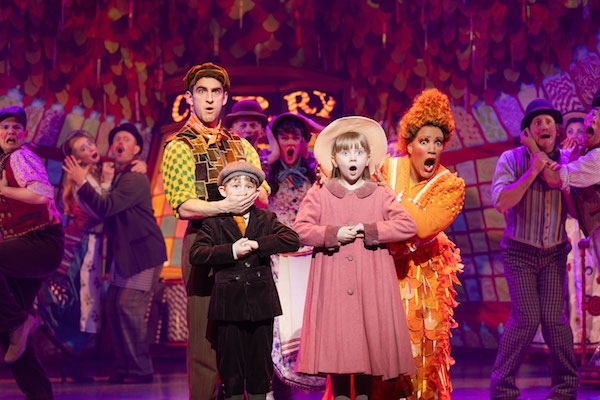
This cosy interior morphs into the exterior nursery roof with the help of atmospheric lighting, well-coordinated tiled gables and a panoramic view of London’s skyline. Beyond the house, a grey, gated park becomes a technicolour wonderland where sculptures leap free from their plinths. A shop with a shimmering orange-and-yellow patchwork canopy roof, like a circus tent, displays jars of sweets in every shade of the rainbow. Here, chatterbox customers pick and mix letters as well as sweeties, so that they can hyperactively concoct their own words... it’s ‘Supercalifragilisticexpialidocious’!
In stark contrast, the bank is menacingly monochrome. Gleaming marble pillars precisely ordered on an incline skew the proportions so that the space is experienced as if from a child's perspective. This intensifies the serious and imposing ambiance, which is so very different to Mary's spellbinding "see the world more upside-down-ish" aura.
Mary takes great pleasure in declaring that she never explains anything. Fittingly, the incredible illusions that bring her playful antics to the stage leave everyone in the audience agog, marvelling at how all the tricks are possible. The bottomless carpet bag full of endless surprises. The levitating housewares. The shelves and table that collapse in chaos only to be restored to their original state with a simple snap of Mary’s fingers. Close your mouth, we are not a codfish!
The dancing – in every room of the house, with real-world and dream-world friends, over rooftops, up walls, across the ceiling and on the breeze – is superb. There is so much to excite, enchant and entertain us in the spectacular choreography (by Matthew Bourne and Stephen Mear). The balletic grace of the dancing statues. The sugar-rush high of the speedy, shapeshifting, sign-language moves in the talking shop. The must-be-seen-to-be-believed tapdancing of the soot-covered chimney sweeps during a sensational night on the tiles.
A live orchestra delivers all the unforgettable and upbeat musical numbers with rousing aplomb. Songs from the film (by the Sherman Brothers: Richard and Robert) are joyfully included, with additional lyrics and arrangements by George Stiles and Anthony Drewe. Stiles and Drewe have also created new songs, which seem right at home on Cherry Tree Lane. ‘Practically Perfect’ captures Mary’s credentials – perfectly. ‘Brimstone and Treacle’ is an operatic antithesis to ‘A Spoonful Of Sugar’ – performed with pantomime-worthy panache to pit Mr Banks’ terrifying childhood nanny, Miss Andrew, against prim-and-proper Poppins. ‘Anything Can Happen’ is wholesomely optimistic – ensuring a fabulously uplifting finale.
I can’t put my finger on exactly how and why but, here and there, the production’s emotional tone lands just shy of perfection. New song ‘Playing The Game’ has Mary bring Jane and Michael's toys to life to teach the children that they must look after their belongings. The children’s refusal to learn their lesson then provides a reason for Mary to disappear. This sets up the second act in which Miss Andrew, “the holy terror”, makes her appearance and the Banks family learn to appreciate what is important in life. The ‘Playing The Game’ scene serves its purpose, but the grown-up-sized dolls and teddies – not to mention the giant clown looming overhead – are creepy. So there!
The show’s running time might also be a spot too long – “enough is as good as a feast” after all. Oh, pish posh though! This show is jolly good fun, totally transporting and bursting with talent.
Stefanie Jones is bewitching as enigmatic, all-knowing Mary Poppins. Jones has an elegantly – sometimes eerily – commanding presence and pristine vocals. Beautifully turned out (her outfits and her stance), she kicks up her heels with poise and pizazz in dance routines. Her impeccable comic timing also means she strikes the balance between stern and loving. Jack Chambers is effortlessly charming as cheeky cockney Bert.
Chambers has an easy rapport with the rest of the cast and the audience. Befitting of Bert’s everyman status, he embodies dance routines with a nimble, natural energy. He is an electrifying dancer; this is shown to maximum effect when he is tapping up a storm.
Michael D Xavier brings depth to George Banks, while Lucie-Mae Sumner plays Winifred Banks with warmth and well-paced wit. Rosemary Ashe and Ruairidh McDonald are full of high jinks in their light-hearted partnership as sharp-tongued housekeeper Mrs Brill and silly house boy Robertson Ay. Wendy Ferguson is a villainous vocal powerhouse as Miss Andrew (styled to look like a hybrid of Ursula from The Little Mermaid and Miss Trunchbull from Matilda).
On press night, the young actors playing Jane and Michael Banks were Connie Jones and Oli Manning. They give pleasingly polished performances that are brimming with personality and feel sincere. Every single member of the company possesses a staggering amount of verve and virtuosity, so the children are in glorious company.
Watching Mary Poppins is a delightful way to put a smile on your face and reconnect with your sense of wonder. But remember, Mary only stays for as long as she is needed. So, spit spot to Milton Keynes Theatre before she flies away to entertain audiences elsewhere.
Running time: Approximately 2 hours 40 minutes, including an interval.
Age guidance: 7+
*Production photography by Danny Kaan.
Mary Poppins continues at Milton Keynes Theatre until Saturday 22 November. The UK tour continues until 31 January 2026.
Georgina Butler is an editor, a dance writer and a ballet teacher.