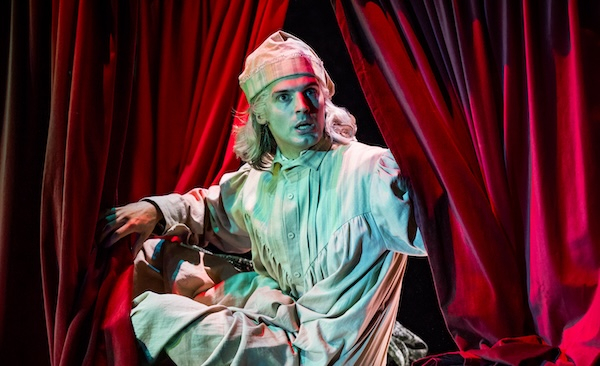

Temperatures are sizzling inside Milton Keynes Theatre this week courtesy of Matthew Bourne’s The Car Man – a slick, steamy, sexy dance thriller, writes Georgina Butler.
This intoxicating production is Georges Bizet’s Carmen reignited in Bourne’s signature dance–theatre style. Inspired by the spirit of seduction and bohemian lifestyle portrayed in the opera, it retains the elements of sexual jealousy and crime passionnel.
However, the plot is radically reworked and the smouldering shenanigans are relocated from the familiar cigarette factory in nineteenth-century Spain to a greasy garage-diner in late 1950s America.
The supercharged storytelling begins as theatregoers enter the auditorium. The cast, in character as residents of the mid-western Italian American town of Harmony, are starting to go about their business onstage. Soon, mechanics are tinkering with clapped-out cars at the dusty garage. Patrons are sipping ice-cold beers, smoking cigarettes and eyeing up more than the specials board at the neon-lit diner.
Tools grind and silverware clinks. A revving car engine roars. A billboard welcomes us to Harmony, reminding us to drive safely. And a handsome stranger saunters into view, immediately captivating cast and audience members alike with his magnetic gaze.
Despite its pleasant name, a heady mix of sweat, car oil and lust has a stifling hold over this town. Hidden desires and interpersonal tensions simmer restlessly – everyone wants something that seems just out of reach. The arrival of a dangerously
charismatic drifter is, unsurprisingly, disruptive. Things suddenly start hotting up in Harmony…
Theatre lovers know that Sir Matthew Bourne OBE does not restage stories for his New Adventures company. He reinvents them. Audiences are advised to expect the unexpected.
His Nutcracker! (1992) is a bittersweet journey from a bleak orphanage to a cartoonish candy kingdom. His Swan Lake ruffled feathers in 1995 when he replaced the traditional female corps de ballet with a menacing male ensemble.
His Cinderella (1997) is set in war-torn London during the Blitz. Bourne’s ability to breathe contemporary relevance into beloved stories – and tell them through character-led movement that draws audiences into the drama rather than distancing them – is brilliant.
The Car Man represented a departure from family storytelling to mature content when it premiered, to critical acclaim, in 2000. The show turns up the heat in a down- and-dirty way – strictly, adults only. It riffs on Carmen, of course, with a recorded soundscape based on the dramatic themes of the opera, punctuated by crickets chirping and castanets clicking. Specifically, it makes use of Carmen Suite, a striking 1967 one-act ballet written for strings and percussion by Russian composer Rodion Shchedrin.
His percussive flair has been further developed by long-standing Bourne collaborator Terry Davies to create a pulsating, modern score. Visually and narratively, though, The Car Man is influenced by gritty American film noir – particularly James M Cain’s The Postman Always Rings Twice (a hardboiled 1934 crime novel, adapted as a classic 1946 film).
Dance drama at its most thrilling, this scorcher of a show drives at full throttle through sultry liaisons and all sorts of twists and turns. Luca, the titular ‘car man’, drifts into town. Responding to a ‘man wanted’ sign outside Dino’s Diner and Garage, he is hired as a mechanic and quickly throws a spanner in the works, turning all the locals’ lives upside down.
Luca begins an affair with Lana, the much younger, and frequently abused, waitress wife of sleazy Dino. While fun-seeking femme fatale Lana plays with fire, her sweet-natured sister, Rita, carries a torch for sensitive car mechanic Angelo. The macho
grease monkeys bully Angelo so, when Luca steps in to protect him, he too falls under Luca’s spell. Cue fighting and fornicating, manipulation and murder, framing and false imprisonment, rage and revenge…
The town of Harmony perpetually throbs with frustrated energy. Fuelled by retro cars and racy choreography, The Car Man has a petrolhead West End Story vibe. With a side order of ‘The Scottish Play’ perhaps – Dino’s inevitable sticky end sees the
murderers behave like the Macbeths.
The set (Lez Brotherston) and lighting (Chris Davey) work in perfect harmony with the narrative thrust. A two-tier tower of steel scaffolding morphs from the garage, which includes a downstairs office and upstairs showers and living quarters, to a seedy cabaret nightclub and then to a grim prison.
The front-facing exterior of the diner, complete with hatch and shutter, proudly serves as the heat-soaked hub of the community, but is pushed flat against the wings when the action relocates.
Tyres, tables and chairs, a couple of vintage cars and a petrol pump set the scenes and are integrated into dance sequences. Throughout the show, every blackout and beam of light adds to the dry humour, pent-up hostility and high-stakes drama. The palette of red, orange and grey lighting evocatively denotes the sweltering climate as well as hot-and-heavy interactions.
The neon glow of the diner’s sign emits a harsh halo of hospitality. A stark spotlight illuminates instances of attraction, infidelity and betrayal.
Car headlights dip and glare. Angry angled shadows are juxtaposed against the woozy haze of desire.
Dancers use every atmospherically lit surface of the set during the choreography, which uses Bourne’s genre-fluid vocabulary of balletic steps fused with earthy contemporary dance and musical theatre techniques. This results in emotive solos, intense duets, rip-roaring social dances and boisterous ensembles.
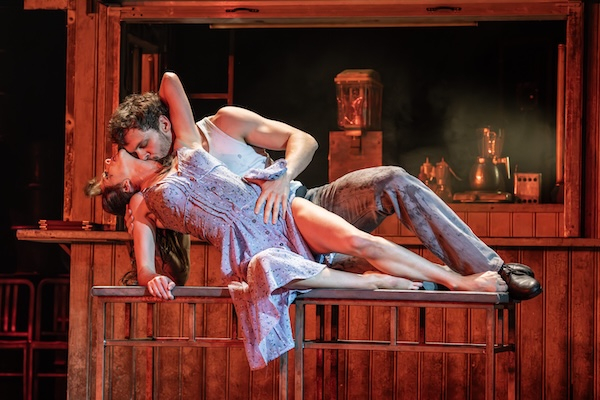
Car hoods pop and the neighbourhood shakes playfully and provocatively (briefly, nakedly). Luca takes what he wants – be it the table, the drink, the girl or the guy. Slow-motion sequences build suspense when eyes lock, fists fight and guilt spirals. Sparks fly when Luca and Lana find themselves alone together.
They abruptly abandon their work tasks – polishing cars and kneading dough, respectively – and surrender themselves to each other, their insatiable sexual appetites overspilling into an orgy scene. (Yes, it is all a bit OTT but roll with it!) Two contrasting duets between Angelo and Rita – the first characterised by innocence and gently intertwining affection; the second showing that they no longer harmoniously fit together, because his soft edges have been irrevocably hardened by trauma – provide essential passages of poignancy amid all the primal urges and predatory behaviours.
New Adventures recruits extremely engaging dance-actors and is renowned for its rotating casts. On press night, seventeen cast members brought the troubled streets of Harmony to the stage.
Among them, Will Bozier gleefully leans into Luca’s sexual ambiguity and confrontational nature, while Cordelia Braithwaite sensually embodies the caged yet calculating Lana.
Together, their Luca and Lana have cheekiness and chemistry. Anna-Maria de Freitas is tender as Rita. Leonardo McCorkindale undergoes a touchingly wretched transformation as Angelo. And Alan Vincent, who originated the role of Luca, plays Dino as a bullying buffoon, making light work of his foreboding presence – in life and in death.
Opening night was an action-packed, theatrical triumph. Whatever casting arrangement you see, expect to leave the auditorium marvelling at The Car Man.
What a ride!
Images: by Johan Persson
Running time: Approximately 2 hours, including an interval.
Age guidance: 12+
Contains scenes of a sexual nature, brief nudity, strobe lighting and gunshots.
Matthew Bourne’s The Car Man continues at Milton Keynes Theatre until Saturday
11 July. The UK tour continues until 21 November.
Book your seat: https://www.atgtickets.com/shows/matthew-bournes-the-car-man/milton-keynes-theatre/
Georgina Butler is an editor, a dance writer and a ballet teacher.
Follow her on X (formerly Twitter) @GeorginaLButler and Instagram @glbdancewriter